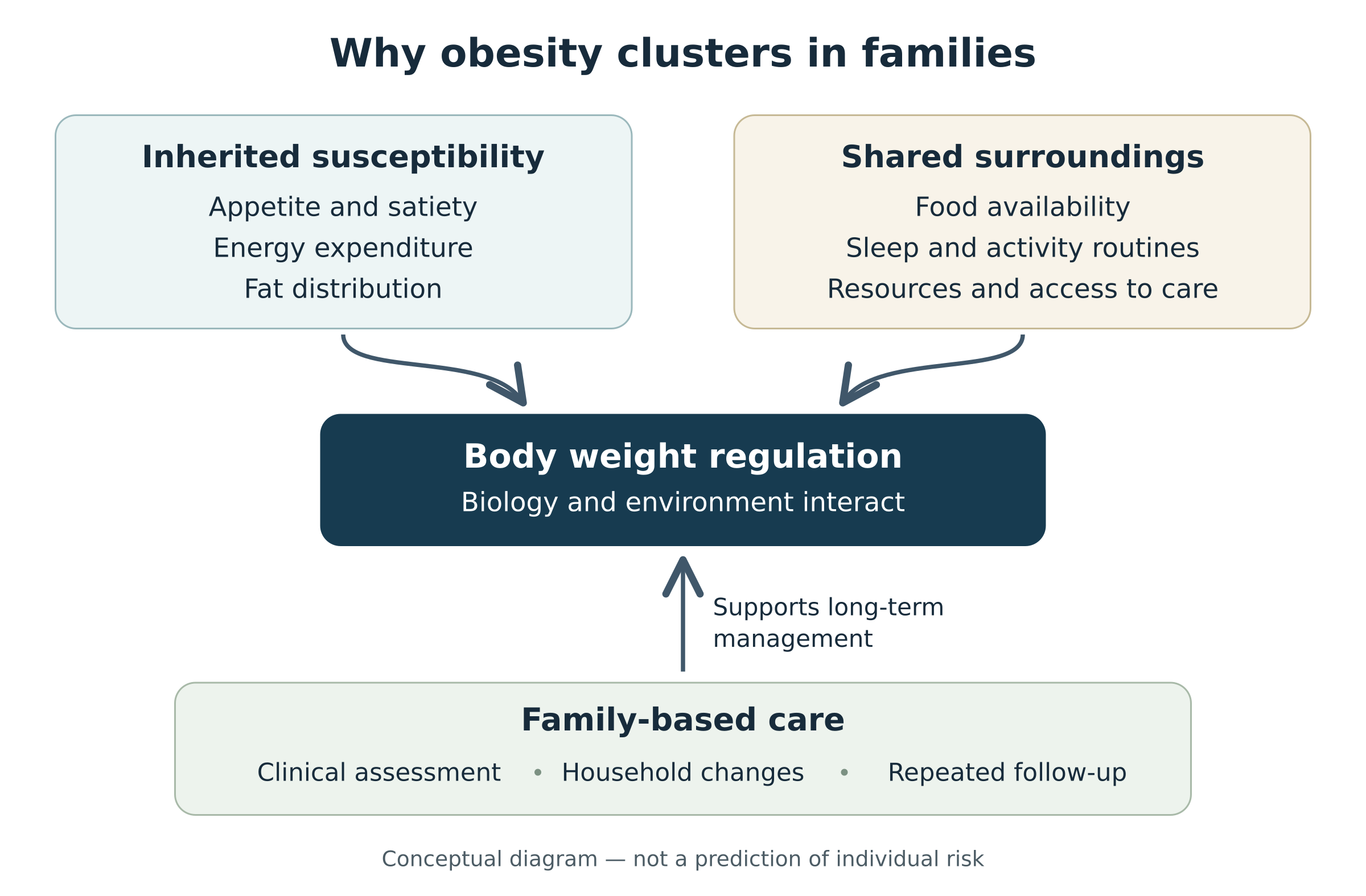
If you are a father with obesity, a useful question is not only how to reduce your own health risks, but how to make healthy routines easier for everyone at home. Children do not need to inherit the same clinical course as their parents. Family history should prompt assessment and support, not resignation.
If several people in the same family struggle with obesity, it is tempting to assume the explanation is simple: bad genes, bad eating habits, or some combination of the two.
The reality is more interesting. Families share DNA, but they also share food environments, sleep patterns, activity habits, social circumstances, and sometimes decades of exposure to the same health risks. The biology that regulates body weight is powerful, and it does not operate independently of the environment.
Understanding that interaction gives us a much more useful approach to prevention and treatment than simply telling everyone to eat less.
Original Man Medicine educational diagram, 2026. Conceptual syn...
LDL cholesterol below 60 mg/dL: the plaque reversal threshold?
For years, “normal” LDL cholesterol has been treated as if it were the same thing as “safe.” It is not.
LDL cholesterol is one part of the atherosclerosis story, but the important exposure is cumulative. The longer arterial walls are exposed to atherogenic lipoprotein particles, the more opportunity there is for particles to enter the arterial wall, become retained, and contribute to plaque formation.
That is why the question is changing. Instead of asking only whether an LDL result is high enough to treat, we should also ask whether it is low enough for the person’s lifetime cardiovascular risk.
The evidence does not support the simplistic claim that an LDL below 60 mg/dL guarantees that a person has no heart disease. It does support a more useful conclusion: lower LDL-C is generally associated with lower atherosclerotic risk, and people with established atherosclerotic cardiovascular disease often benefit from intensi...
Most conversations about obesity eventually come back to the same advice: eat less and move more. That advice is not entirely wrong, but it is an incomplete description of a remarkably complicated biological system.
Energy balance still determines whether body energy stores increase or decrease. What it does not explain, by itself, is why two people living in similar environments can have very different appetite signals, adipose-tissue responses, metabolic adaptations, and long-term weight trajectories.
One potentially relevant influence is exposure to environmental obesogens: substances capable of altering biological pathways involved in fat-cell development, lipid handling, or energy regulation. These compounds have attracted considerable attention, particularly because exposure may begin before birth.
There is legitimate science here. There is also a substantial difference between demonstrating that a chemical changes adipocyte differentiation in a laboratory and demonstrating th...
Most people step onto a scale, see a number, and assume it tells them something meaningful about their health. It tells them how much they weigh. It does not tell them how much of that weight is fat, how much is lean tissue, or where the fat is stored.
That is why body-composition testing has become popular. Among the available methods, dual-energy X-ray absorptiometry—usually called DXA or DEXA—is particularly useful. But there is a distinction to understand before you become too attached to a body-fat percentage printed on a report:
DEXA is a good measurement tool. It is not a perfect measurement of biological truth.
What does a DEXA scan actually measure?
DEXA uses two X-ray energies that are attenuated differently as they pass through tissue. Software analyzes those signals to estimate three main compartments: bone mineral content, fat mass, and lean soft tissue. A whole-body scan can also divide the results into regions such as the arms, legs, and trunk. The test is relatively...
Protein powder has a straightforward job: make it easier to get
enough protein. The decision becomes more complicated when the container
also promises better recovery, more muscle, easier weight loss, and a
healthier future.
Before choosing a product, separate two questions. Does it contain
what the label says? And does adding it actually improve your diet? A
product can pass the first test and still be unnecessary for you.
A useful warning about
label accuracy
In its April
30, 2026 report, ConsumerLab said six of 21 independently selected
powders and shakes failed testing because cholesterol, sodium, or sugar
exceeded label claims. All 21 met their protein claims. Failures were
confirmed at a second laboratory. Eight additional products submitted
through its voluntary certification program passed. The reported 29%
failure rate therefore refers to the independently selected group, not
all 29 products.
This was product testing, not a clinical trial. It did not measure
whether users gain...
Why a weaker stream, an enlarged prostate, and a rising PSA are different clinical questions.
If you already get up at night to urinate, or your stream has become weaker, it is reasonable to ask whether starting testosterone will make the problem worse. The prostate responds to androgens, so the concern has a biological basis. But the chain of events often presented to men—more testosterone, a larger prostate, more obstruction, worse urination—is much less predictable than it sounds.
In men with confirmed testosterone deficiency and without severe urinary symptoms at baseline, randomized trials have generally found no worsening of average urinary symptom scores with testosterone replacement. That is useful reassurance for appropriately selected patients. It does not establish safety in every man, settle the consequences of decades of treatment, or show that testosterone should be prescribed to treat an enlarged prostate. 1,2,3
To apply the research to your own situation, start wit
You start taking creatine, continue training, and your next blood test shows a higher creatinine. The laboratory also reports a lower estimated kidney filtration rate. Did the supplement injure your kidneys?
Possibly, but those two numbers do not establish that diagnosis. Creatinine can increase because your kidneys are clearing less of it, because your body is generating more of it, or because both processes have changed. The job is to distinguish those explanations without dismissing a genuine kidney problem.
This is particularly relevant if you lift weights, carry substantial muscle mass, or use testosterone. A laboratory equation is useful, but it does not know your training history or what is in your supplement container.
Start with the extra syllable
Creatine and creatinine are related compounds, but they are not interchangeable. Creatine participates in the phosphocreatine system inside muscle. When a muscle contracts, adenosine triphosphate, or ATP, supplies ene...
Lighter loads can build muscle when the sets are sufficiently demanding. A new trial favoured lighter weights for elbow-flexor growth, but the finding needs to be read alongside its design, the broader evidence and the distinct demands of maximal strength.
You can build muscle with relatively light weights. The qualification is that the sets must be demanding enough, particularly as the weight gets lighter. Twenty repetitions with another 20 available represent a different stimulus from 20 repetitions that bring the target muscle close to its limit.[3][7][8]
A 2026 randomised trial found greater elbow-flexor muscle-thickness gains with lighter than heavier loads. Before changing an entire training programme on that basis, consider who was studied, how they trained and what the outcome actually measures.[1]
Photo: Man Medicine archive.
What the new trial found
Hammert and colleagues randomly assigned 201 previously untrained adults, with a mean age of approximately 21 years, to four gro...
A modest increase in Lp(a) usually does not justify stopping an indicated statin. The clinical interpretation depends on the absolute concentration, the quality of the measurement, and the strength of the outcome evidence.
A modest rise in lipoprotein(a), or Lp(a), after starting a statin usually isn't a reason to stop an otherwise indicated treatment. Elevated Lp(a) remains a cardiovascular risk factor even when LDL cholesterol falls. The question is whether a treatment-associated change alters the balance of benefit and risk, and which evidence can actually answer that question.[4][6][7][8]
Why Lp(a) behaves differently
Lp(a) contains an LDL-like particle carrying apolipoprotein B-100, with apolipoprotein(a), or apo(a), attached by a disulfide bond. The additional protein changes the particle's biology. Its size varies substantially because people inherit different numbers of repeating kringle IV type 2 domains. Those differences contribute to variation in circulating concentratio...
Persistent erectile dysfunction can identify an opportunity to assess vascular risk earlier. The mechanisms are plausible and the association is clinically relevant, but neither establishes a coronary diagnosis.
Persistent erectile dysfunction deserves a cardiovascular assessment, particularly when it develops gradually without an obvious explanation. The useful question is whether the same vascular pathology is affecting erectile function and increasing cardiovascular risk. Answering that takes more than a testosterone measurement or a prescription for tadalafil.[6][7]
A 2026 perspective in Medicina revisits this connection, bringing together vascular physiology, observational studies, and recommendations from the Princeton IV Consensus. There are no new patients, no randomized intervention, and no systematic meta-analysis in that paper. Its value is in connecting existing evidence. Each component still needs to be judged on what it actually establishes.[1]