Oct 26, 2026
If you are a father with obesity, a useful question is not only how to reduce your own health risks, but how to make healthy routines easier for everyone at home. Children do not need to inherit the same clinical course as their parents. Family history should prompt assessment and support, not resignation.
If several people in the same family struggle with obesity, it is tempting to assume the explanation is simple: bad genes, bad eating habits, or some combination of the two.
The reality is more interesting. Families share DNA, but they also share food environments, sleep patterns, activity habits, social circumstances, and sometimes decades of exposure to the same health risks. The biology that regulates body weight is powerful, and it does not operate independently of the environment.
Understanding that interaction gives us a much more useful approach to prevention and treatment than simply telling everyone to eat less.
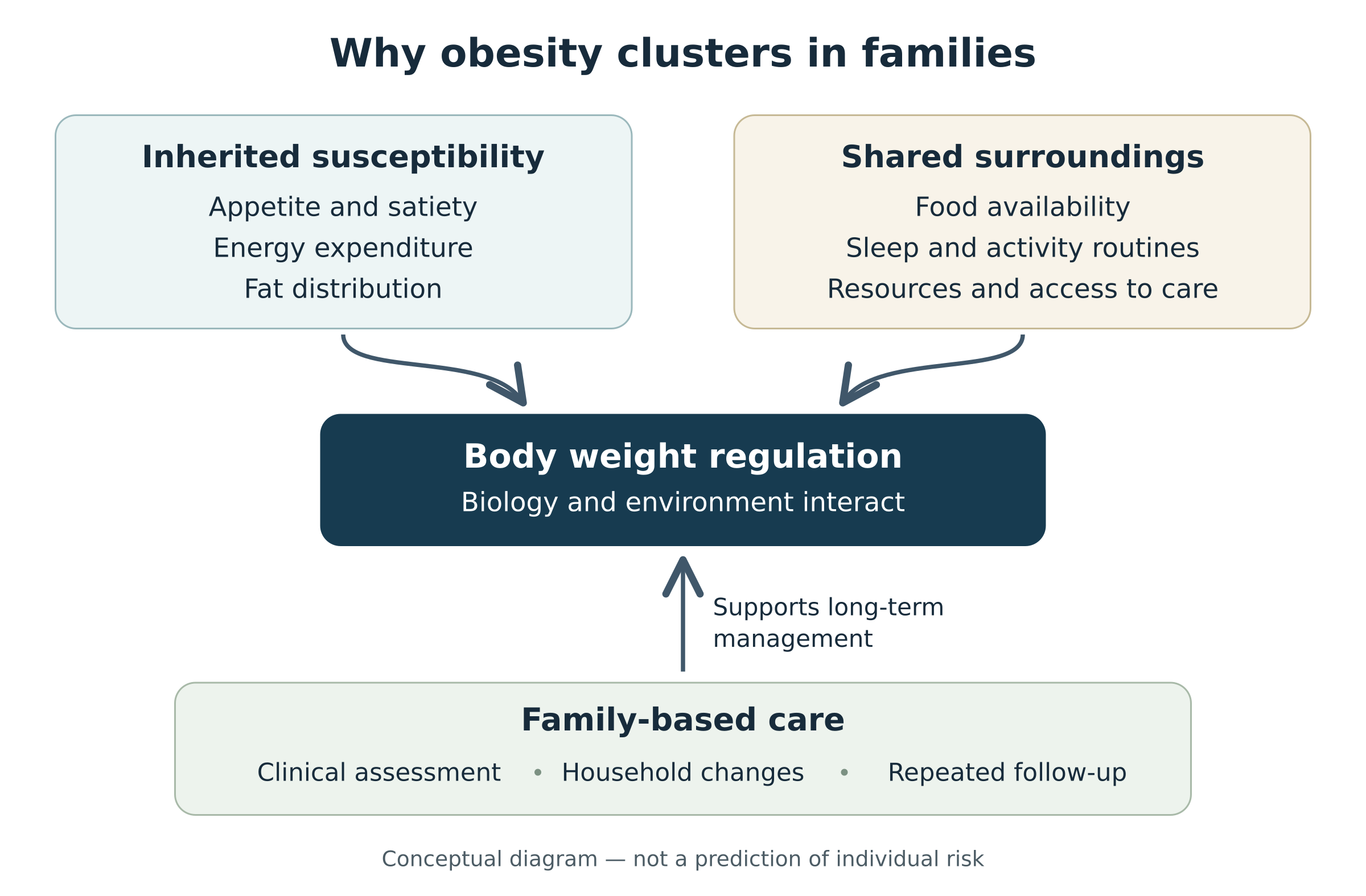
Appetite regulation, satiety, energy expenditure, and fat distribution are influenced by hundreds of genetic variants. Rare single-gene disorders can cause severe early-onset obesity, but most cases reflect many genetic variants interacting with environmental exposures.
An important 2025 study in PLOS Genetics analyzed genetic and weight data from 2,630 mother–father–child trios in the UK Millennium Cohort Study. The investigators used genetically informed analyses to distinguish the effects of genes transmitted to children from potential indirect parental influences.
Both parents' body mass indexes (BMIs) correlated with their children's BMIs. But after accounting for direct genetic inheritance, the association for fathers was close to zero. An association for maternal BMI persisted, particularly during adolescence. The authors interpreted this as evidence consistent with a possible maternal environmental or developmental contribution beyond inherited genes. The analysis cannot determine precisely whether the mechanism is prenatal exposure, parenting, diet, or another correlated factor, and the investigators emphasized the need for replication. The selected sample was of European ancestry, parental BMI was self-reported, and genetically informed estimates depend on assumptions, including how genetic variants influence other traits. A near-zero paternal estimate in this model does not mean fathers cannot influence a child's food, sleep, or activity environment. [1]
This is a useful illustration of why a family history of obesity is neither irrelevant nor destiny. It tells us something about risk, but it does not identify a single cause or prescribe a single treatment.
Think about what a child learns without anyone giving a formal lesson.
What constitutes a normal portion? Is a sugary drink an everyday beverage? Is food routinely used as a reward? Does everyone sit in front of a screen during meals? Is being physically active part of daily life, or does it require a major scheduling effort?
These are not trivial details. They are repeated exposures that can influence energy intake and behavior for years. They are also shaped by circumstances outside an individual family's control: work schedules, income, food costs, transportation, neighborhood safety, and access to healthcare.
Controlled experimental research supports the importance of the food environment. In a small NIH randomized crossover trial, 20 adults spent two weeks eating an ultra-processed diet and two weeks eating an unprocessed diet, with foods offered freely. Although the diets were designed to be comparable in several nutritional characteristics, participants consumed approximately 508 additional kilocalories per day during the ultra-processed phase and gained an average of 0.9 kg; they lost approximately 0.9 kg during the unprocessed phase. [2]
That is a striking result, but it is not proof that every ultra-processed product causes obesity. The trial was short, included only 20 adults, and was conducted in a controlled inpatient setting. What it does show is that food characteristics and eating environments can alter spontaneous calorie intake even when participants are not instructed to overeat.
Obesity is not simply the passive accumulation of excess calories. Body weight is regulated through integrated hormonal and neural systems. Leptin, released by fat cells, helps signal stored energy to the brain. Insulin and gut-derived peptides also participate in appetite regulation. The hypothalamus integrates these signals with other information, while reward circuits influence how strongly we want particular foods. These systems influence both eating behavior and energy expenditure. They are not a simple switch that can be reset by willpower. [7]
When weight falls, appetite may increase and energy expenditure may decrease relative to what would otherwise be expected. These responses make long-term maintenance difficult. They do not make weight loss impossible, but they help explain why sustained success often requires a sustained treatment strategy.
We can see this in pharmacotherapy studies. In the STEP 1 extension, a subgroup of 327 adults was followed for one year after stopping semaglutide and structured lifestyle support. Participants previously treated with semaglutide regained, on average, about two-thirds of the weight they had lost. This exploratory follow-up does not establish what will happen to every patient, but it demonstrates why we should think of effective obesity treatment as chronic management rather than a brief corrective intervention. [3]
This is where recent randomized trials become particularly relevant.
A 2023 JAMA trial randomized 452 children aged 6–12 years, along with participating parents, to family-based behavioral treatment or usual care. At 24 months, the intervention produced better child weight outcomes, with an adjusted between-group difference of −6.21 percentage points in percentage above the age- and sex-specific median BMI (95% CI, −10.14 to −2.29). Benefits were also observed across family members in longitudinal analyses, including siblings who were not the primary treatment target. [4]
In July 2026, the TEAM UP trial extended this evidence into a broader group of primary care practices. Investigators randomized 730 children aged 6–15 years across 41 clinics to enhanced standard care, with or without an additional structured family-based program.
At 12 months, the added family-based intervention reduced the child's percentage above median BMI by 6.4 units, compared with 2.6 units for enhanced standard care alone—a between-group difference of 3.8 percentage points (95% CI, 1.34–6.20 in favor of family treatment; P = .002). By 18 months, 42% of children in the family-based treatment group achieved the study's threshold for a clinically meaningful reduction in BMI z score. [5]
These are not percentages of total body weight lost. They are pediatric growth-adjusted BMI measures, which should not be confused with the adult weight-loss percentages reported in drug trials.
There are important limitations. Both groups received active care. Families were not blinded to treatment, and the added intervention demanded substantial time and trained staff. Average attendance was approximately 17 sessions, despite a higher intended dose, and participation was affected by socioeconomic and access barriers. The findings support family-based care; they do not imply that a few nutrition handouts will reproduce these outcomes.
First, evaluate the whole clinical picture. For adults, that means looking beyond BMI to waist circumference, blood pressure, glycemic status, lipids, sleep, medications, body composition when useful, and complications such as metabolic dysfunction–associated steatotic liver disease. In children, BMI must be interpreted using age- and sex-specific growth references, with assessment tailored to age and clinical findings.
Second, change the default household environment. Make nutritious, satiating foods easier to access. Replace routine sugar-sweetened beverages with water or other unsweetened options. Build regular meals around adequate protein, minimally processed foods, vegetables, fruit, and high-fiber carbohydrates. The goal is a sustainable pattern, not a rigid list of forbidden foods.
Third, make activity something the household does, not an instruction given to one person. Walk after dinner, find an activity the children enjoy, and include age-appropriate strength and aerobic exercise. Physical activity improves cardiometabolic fitness even when the scale changes little.
Fourth, pay attention to sleep and the practical barriers to change. Shift work, chronic sleep restriction, untreated sleep apnea, food insecurity, medication-induced weight gain, and family stress can undermine an otherwise reasonable plan. These issues deserve clinical attention rather than another lecture about motivation.
Fifth, use structured treatment when indicated. The strongest pediatric behavioral studies involved coaching, monitoring, positive parenting strategies, problem-solving, and repeated follow-up. The American Academy of Pediatrics recommends intensive family-based health behavior and lifestyle treatment. Its guideline advises offering adjunct weight-management medication to adolescents aged 12 years and older with obesity, according to the medication's indications, risks, and benefits. For adolescents aged 13 years and older with severe obesity, it advises referral for evaluation at a comprehensive pediatric metabolic and bariatric surgery center. A referral is not a recommendation that every adolescent undergo surgery. Treatment choices must be individualized, developmentally appropriate, and consistent with local approvals and specialist assessment. [6]
Most importantly, avoid turning a child's body weight into a source of shame. Focus on health, function, habits, and the home environment. Parents should model the behaviors they want to encourage rather than place the entire burden on one family member.
Children should not be put on an adult's calorie-restricted diet without pediatric guidance. A clinician should also assess growth, mood, bullying, and disordered eating. If a child has very early, severe obesity or unusually intense hunger, that history may warrant specialist evaluation rather than simply escalating restrictions. [6]
Obesity often clusters in families because genes and environments travel together. We cannot change the genes a child inherits, but we can identify many of the exposures that shape health across a lifetime.
The practical strategy is not to blame the parents or tell the child to try harder. It is to identify the relevant biology, assess metabolic complications, improve the family's environment, and offer evidence-based treatment at an intensity that matches the problem.
A family history of obesity is a reason to intervene intelligently—not a reason to assume the outcome is inevitable.
This article is for education and does not replace individualized medical care. Medication and surgical decisions require a qualified clinician who can assess the individual patient.
