Oct 26, 2026
If you are a father with obesity, a useful question is not only how to reduce your own health risks, but how to make healthy routines easier for everyone at home. Children do not need to inherit the same clinical course as their parents. Family history should prompt assessment and support, not resignation.
If several people in the same family struggle with obesity, it is tempting to assume the explanation is simple: bad genes, bad eating habits, or some combination of the two.
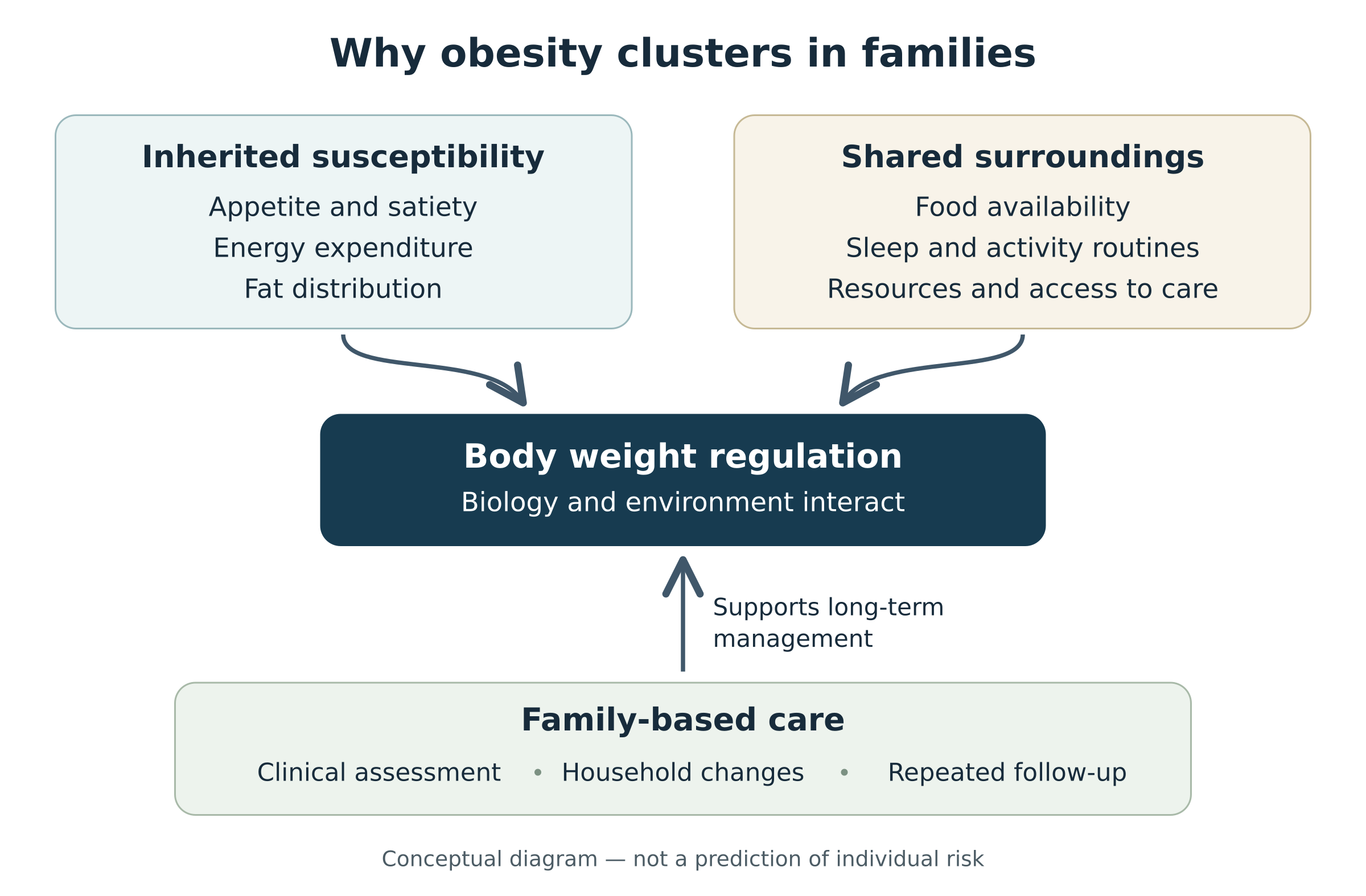
The reality is more interesting. Families share DNA, but they also share food environments, sleep patterns, activity habits, social circumstances, and sometimes decades of exposure to the same health risks. The biology that regulates body weight is powerful, and it does not operate independently of the environment.
Understanding that interaction gives us a much more useful approach to prevention and treatment than simply telling everyone to eat less.
Oct 23, 2026
Most conversations about obesity eventually come back to the same advice: eat less and move more. That advice is not entirely wrong, but it is an incomplete description of a remarkably complicated biological system.
Energy balance still determines whether body energy stores increase or decrease. What it does not explain, by itself, is why two people living in similar environments can have very different appetite signals, adipose-tissue responses, metabolic adaptations, and long-term weight trajectories.
One potentially relevant influence is exposure to environmental obesogens: substances capable of altering biological pathways involved in fat-cell development, lipid handling, or energy regulation. These compounds have attracted considerable attention, particularly because exposure may begin before birth.
There is legitimate science here. There is also a substantial difference between demonstrating that a chemical changes adipocyte differentiation in a laboratory and demonstrating th...
Oct 17, 2026
Most people step onto a scale, see a number, and assume it tells them something meaningful about their health. It tells them how much they weigh. It does not tell them how much of that weight is fat, how much is lean tissue, or where the fat is stored.
That is why body-composition testing has become popular. Among the available methods, dual-energy X-ray absorptiometry—usually called DXA or DEXA—is particularly useful. But there is a distinction to understand before you become too attached to a body-fat percentage printed on a report:
DEXA is a good measurement tool. It is not a perfect measurement of biological truth.
DEXA uses two X-ray energies that are attenuated differently as they pass through tissue. Software analyzes those signals to estimate three main compartments: bone mineral content, fat mass, and lean soft tissue. A whole-body scan can also divide the results into regions such as the arms, legs, and trunk. The test is relatively...
