Oct 23, 2026
Most conversations about obesity eventually come back to the same advice: eat less and move more. That advice is not entirely wrong, but it is an incomplete description of a remarkably complicated biological system.
Energy balance still determines whether body energy stores increase or decrease. What it does not explain, by itself, is why two people living in similar environments can have very different appetite signals, adipose-tissue responses, metabolic adaptations, and long-term weight trajectories.
One potentially relevant influence is exposure to environmental obesogens: substances capable of altering biological pathways involved in fat-cell development, lipid handling, or energy regulation. These compounds have attracted considerable attention, particularly because exposure may begin before birth.
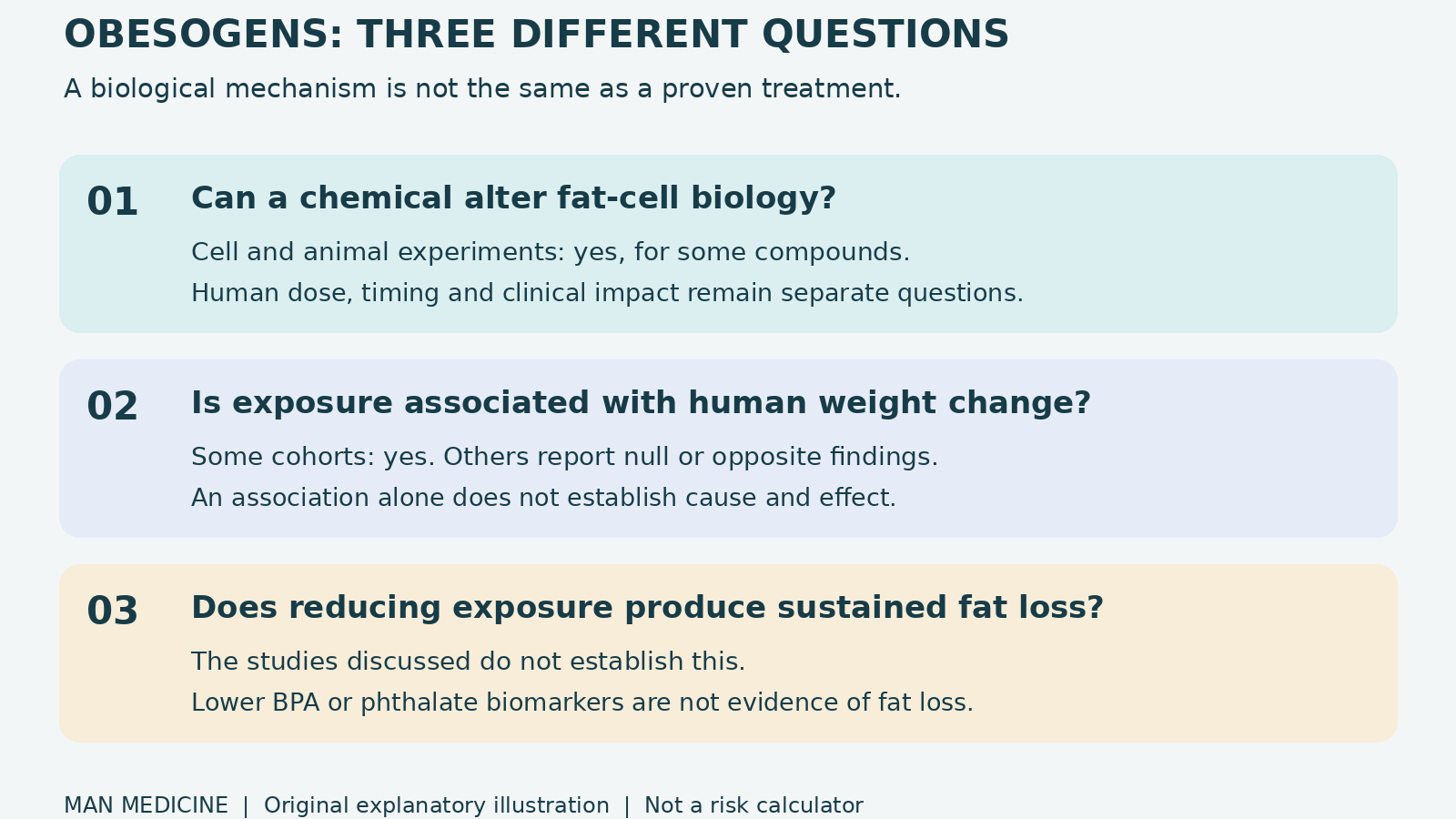
There is legitimate science here. There is also a substantial difference between demonstrating that a chemical changes adipocyte differentiation in a laboratory and demonstrating that ordinary human exposure causes clinically important obesity. We need to keep those two propositions separate.
The term obesogen was introduced to describe environmental chemicals that may promote adiposity by interfering with endocrine and metabolic signaling [1].
The hypothesis is broader than the familiar idea that an endocrine disruptor simply imitates estrogen or blocks testosterone. Depending on the chemical, the potential targets include nuclear receptors, adipocyte precursor cells, insulin signaling, mitochondrial function, and central neuroendocrine circuits involved in feeding behavior.
The chemicals most commonly discussed include organotins such as tributyltin, bisphenols used in some plastics and resins, certain phthalates, and some per- and polyfluoroalkyl substances (PFAS). These are not one pharmacologic class. Their structures, persistence, exposure routes, and biological effects differ considerably. Calling them all “obesogens” should not be mistaken for proof that each causes weight gain in humans.
A 2024 review proposes that disrupted cellular redox signaling may connect some environmental exposures with insulin secretion, appetite regulation and fat storage [10]. Redox signaling refers to controlled chemical reactions involving electron transfer, including signals generated by reactive oxygen species. This is a proposed integrative mechanism, not a proven single explanation for human obesity. It does not establish that antioxidant supplements treat exposure-related weight gain.
One of the most compelling mechanistic findings came from work by Grün and colleagues in 2006 [2].
They investigated tributyltin, an organotin compound with environmental applications and historical use in antifouling products. In cell and animal experiments, tributyltin activated peroxisome proliferator-activated receptor gamma (PPARγ) and retinoid X receptor (RXR). PPARγ is a central transcriptional regulator of adipocyte differentiation. Activating that pathway can push precursor cells toward becoming mature fat cells.
The investigators observed increased adipogenesis in cultured cells and altered lipid accumulation after exposure in developing animals. That is direct experimental evidence that a contaminant can interact with the machinery controlling adipose-tissue development.
But an essential qualification follows: the experiment did not establish that typical human tributyltin exposure causes obesity, nor did it provide a clinically useful threshold for human risk. Experimental receptor activation, developmental effects in animals, and population-level human disease are different levels of evidence.
This is where the research becomes particularly interesting. If an exposure changes the number or functional properties of adipocytes during a critical developmental window, its consequences might persist long after the exposure itself. That is a biologically plausible hypothesis. Whether it contributes materially to an individual adult's obesity remains unresolved.
Human evidence is more complicated and less consistent than the mechanistic literature sometimes suggests.
A frequently cited analysis used data from 621 adults with overweight or obesity participating in the two-year POUNDS LOST dietary trial [3]. Researchers measured baseline blood concentrations of several PFAS compounds and examined weight and resting metabolic rate over time.
Participants lost an average of 6.4 kg in the first six months and subsequently regained an average of 2.7 kg between months 6 and 24. Higher baseline PFAS concentrations were associated with greater subsequent weight regain, particularly in women. For example, among women, adjusted mean regain in the highest versus lowest PFOS tertile was 4.0 versus 2.1 kg.
The authors also reported associations with changes in resting metabolic rate. For male readers, the strongest weight-regain associations were in women; the result is not a numerical prediction of a man's response.
These findings are provocative, but the distinction between study designs is crucial. The diet assignments were randomized; PFAS exposure was not. The PFAS analysis was observational within a randomized dietary trial. Residual confounding, correlated dietary exposures, and other factors cannot be excluded. The study does not show that removing PFAS exposure will prevent weight regain.
A later analysis of the European DioGenes trial examined 381 participants, including 115 men, who had already achieved substantial weight loss. Higher baseline PFOA and PFHxS concentrations were associated with more regain over the next 26 weeks [9]. The direction supports the earlier concern, but again the chemical exposures were not randomized. Statistical adjustment for sex is not proof that the effect is identical in men and women, and neither analysis tested whether lowering PFAS exposure improves weight maintenance.
There are also important counterexamples. In the prospective Upstate KIDS cohort, investigators examined chemical concentrations in newborn dried blood spots and growth during early childhood [4]. Higher neonatal PFOS and PFOA concentrations were associated with slightly lower, not higher, BMI among singletons, and neither compound was associated with early childhood obesity. BPA results were difficult to interpret because measurement in newborn blood may reflect transient exposure associated with medical care.
The point is not that environmental exposure is irrelevant. It is that findings vary by chemical, developmental stage, exposure measurement, population, and outcome.
Bisphenol A (BPA) and several phthalates have been investigated because they are used in a range of industrial and consumer materials and because some can interact with endocrine pathways.
A 2023 meta-analysis of observational studies reported positive associations between several urinary phthalate metabolites and measures of obesity, with results differing by age, sex, and the specific metabolite [5]. But observational associations have familiar limitations: exposure may correlate with food choices, packaging, socioeconomic variables, and other determinants of adiposity. Urinary concentrations of short-lived chemicals also fluctuate and may not accurately reconstruct the biologically relevant exposure window.
The broader literature is not unidirectional. A separate systematic review and meta-analysis examining prenatal phthalate exposure reported associations with lower childhood BMI rather than a consistent obesogenic effect [6].
These discrepancies do not invalidate the field. They argue against claiming that a measured BPA or phthalate concentration predicts how much fat an individual will gain.
There is now also short-term randomized human evidence for a metabolic effect. In a 2026 double-blind trial, 40 healthy, normal-weight adults, including 18 men, received oral BPA at 50 micrograms/kg body weight daily or placebo for five days [13]. Insulin sensitivity measured by a glucose-clamp test declined with BPA relative to placebo, while body weight did not differ statistically. This supports a causal effect under the tested conditions, not proof of chronic obesity at typical environmental doses. The small, young sample, deliberate dose and short duration limit extrapolation.
Here the evidence becomes more practical, although we need to be precise about the outcome being measured.
In a small intervention involving 20 participants from five families, researchers replaced participants' usual diets with fresh foods that were not canned or packaged in plastic for three days [7]. Geometric-mean urinary BPA concentrations fell by approximately 66%, and the measured DEHP phthalate metabolites fell by roughly 53–56%. These were group changes in exposure biomarkers, not reductions in disease risk.
In a randomized crossover study, 75 of 84 volunteers completed five-day periods consuming canned soup and fresh soup, separated by a two-day washout. The canned-soup period produced a marked increase in urinary BPA relative to the fresh-soup period [8]. This was one soup brand studied in 2010; it should not be treated as a measurement of every canned product sold today.
These studies support a defensible conclusion: food sourcing and packaging can substantially change biomarkers of exposure, sometimes within days.
They do not establish that those exposure reductions produce fat loss, reverse insulin resistance, improve fertility, or prevent cardiovascular events. The interventions were short, the primary outcomes were exposure biomarkers, and neither study was designed to demonstrate a clinically meaningful change in adiposity.
The 2026 PERTH pilot randomized trial adds more current evidence [12]. Sixty Australian adults were assigned to five groups for seven days, using different combinations of low-plastic food, kitchenware and personal-care products. Selected urinary bisphenol and phthalate markers fell with the dietary intervention. However, body weight, body composition and clinical blood biomarkers remained stable. Its short duration cannot settle long-term benefits or harms; it demonstrates modifiable exposure, not an obesity treatment.
Reducing a biomarker is not automatically equivalent to improving a patient-oriented outcome.
An established obesity evaluation should not be replaced with an elaborate “toxin panel.” Difficult weight loss cannot be attributed to chemical exposure without evidence.
For someone struggling with excess adiposity, clinical assessment should remain focused on established causes and complications: assess the distribution and consequences of adiposity; examine nutrition and physical activity; evaluate sleep, medications, cardiometabolic risk, and relevant endocrine disorders; and consider evidence-based obesity pharmacotherapy or bariatric treatment when indicated.
At the same time, there are reasonable ways to reduce avoidable exposure without turning daily life into a toxicology experiment.
First, reduce unnecessary contact between hot food and plastic. Use microwave-safe glass or ceramic for reheating. Glass or stainless steel can be useful for storage, but metal containers do not belong in an ordinary microwave. Avoid heating food in containers not intended for that purpose. This is a precautionary exposure-reduction measure, not a demonstrated weight-loss treatment.
Second, favor fresh or minimally packaged food when practical. This may reduce contact with selected food-packaging chemicals; the direct intervention evidence supports changes in BPA and DEHP exposure biomarkers [7]. It may also improve dietary quality, but those are two separate mechanisms and should not be conflated.
Third, treat contaminated drinking water as a specific environmental-health problem. Where local testing demonstrates PFAS contamination, choose a filtration system certified for the relevant contaminants and follow maintenance requirements. Do not assume that any generic filter removes every PFAS compound. Check the specific certified reduction claim and the manufacturer's replacement schedule, rather than relying on a generic certification logo [11].
Finally, be skeptical of commercial detoxification claims. There is no persuasive clinical evidence that proprietary cleanses, intravenous “detox” regimens, or expensive consumer panels reverse obesity by removing environmental obesogens. Exposure prevention and evidence-based medical treatment are more defensible approaches.
The obesogen hypothesis asks a legitimate and important question: might some environmental chemicals alter the way human adipose tissue develops or the way the body regulates energy?
For particular chemicals in experimental systems, the answer is yes. For ordinary human exposures, the evidence supports concern and further research but does not yet provide a quantitative explanation for the obesity epidemic or a validated treatment strategy based on chemical avoidance alone.
We should neither dismiss environmental endocrinology nor use it to sell a new simplistic explanation for obesity.
The next step is better human evidence: prospectively measured exposures, clear developmental windows, repeated body-composition assessments, careful adjustment for diet and socioeconomic factors, and ideally interventions that demonstrate improved clinical outcomes, not merely lower urinary concentrations of chemicals.
Until then, sensible exposure reduction can sit alongside established obesity treatment. It should not replace it.
Educational information, not a diagnosis or individualized treatment plan. Suspected occupational or drinking-water exposure warrants advice from the relevant environmental-health service and a clinician.
Grün F, Blumberg B. Environmental obesogens: organotins and endocrine disruption via nuclear receptor signaling. Endocrinology. 2006;147(6 Suppl):S50–S55. Read source
Grün F, Watanabe H, Zamanian Z, et al. Endocrine-disrupting organotin compounds are potent inducers of adipogenesis in vertebrates. Molecular Endocrinology. 2006;20(9):2141–2155. Read source
Liu G, Dhana K, Furtado JD, et al. Perfluoroalkyl substances and changes in body weight and resting metabolic rate in response to weight-loss diets: a prospective study. PLoS Medicine. 2018;15(2):e1002502. Read source
Yeung EH, Bell EM, Sundaram R, et al. Examining endocrine disruptors measured in newborn dried blood spots and early childhood growth in a prospective cohort. Obesity. 2019;27(1):145–151. Read source
Wu Q, Li G, Zhao CY, Na XL, Zhang YB. Association between phthalate exposure and obesity risk: a meta-analysis of observational studies. Environmental Toxicology and Pharmacology. 2023;102:104240. Read source
Lee DW, Lim HM, Lee JY, et al. Prenatal exposure to phthalate and decreased body mass index of children: a systematic review and meta-analysis. Scientific Reports. 2022;12:8961. Read source
Rudel RA, Gray JM, Engel CL, et al. Food packaging and bisphenol A and bis(2-ethylhexyl) phthalate exposure: findings from a dietary intervention. Environmental Health Perspectives. 2011;119(7):914–920. Read source
Carwile JL, Ye X, Zhou X, Calafat AM, Michels KB. Canned soup consumption and urinary bisphenol A: a randomized crossover trial. JAMA. 2011;306(20):2218–2220. Read source
Grandjean P, Meddis A, Nielsen F, et al. Weight loss relapse associated with exposure to perfluorinated alkylate substances. Obesity. 2023;31(6):1686–1696. Read source
Heindel JJ, Lustig RH, Howard S, Corkey BE. Obesogens: a unifying theory for the global rise in obesity. International Journal of Obesity. 2024;48:449–460. Read source
US Environmental Protection Agency. Identifying drinking water filters certified to reduce PFAS. Accessed October 20, 2026. Read source
Harray AJ, Lucas AD, Herrmann SE, et al. Low-plastic diet and urinary levels of plastic-associated phthalates and bisphenols: the randomized controlled PERTH Trial. Nature Medicine. 2026;32:1871–1883. Read source
Seal AD, Phelan S, Malin SK, et al. Bisphenol A decreases peripheral insulin sensitivity in normal weight adults: a double-blind randomized controlled trial. Journal of Clinical Endocrinology & Metabolism. 2026;111(9):2610–2619. Read source
