Oct 11, 2026
Lighter loads can build muscle when the sets are sufficiently demanding. A new trial favoured lighter weights for elbow-flexor growth, but the finding needs to be read alongside its design, the broader evidence and the distinct demands of maximal strength.
You can build muscle with relatively light weights. The qualification is that the sets must be demanding enough, particularly as the weight gets lighter. Twenty repetitions with another 20 available represent a different stimulus from 20 repetitions that bring the target muscle close to its limit.[3][7][8]
A 2026 randomised trial found greater elbow-flexor muscle-thickness gains with lighter than heavier loads. Before changing an entire training programme on that basis, consider who was studied, how they trained and what the outcome actually measures.[1]
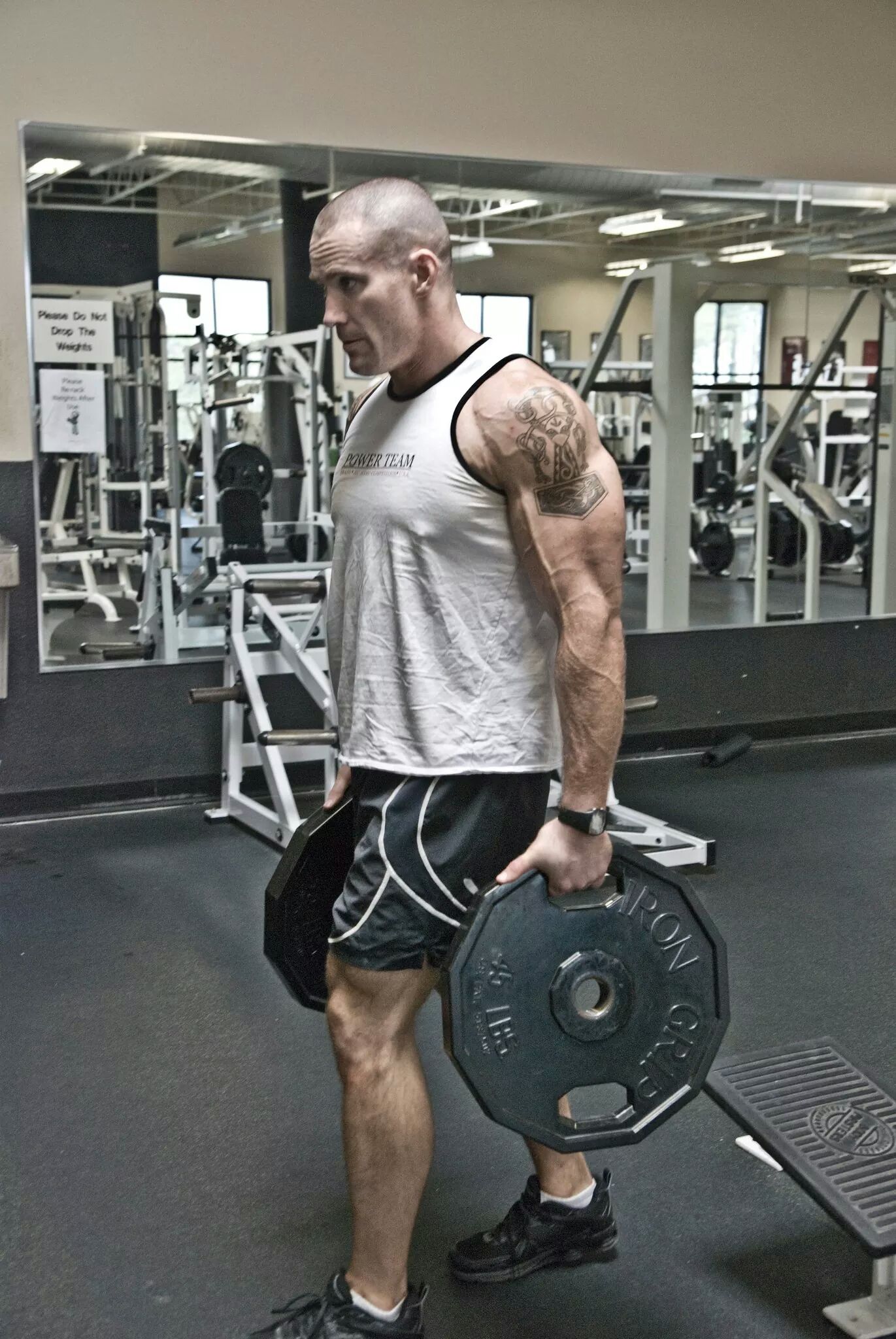
Hammert and colleagues randomly assigned 201 previously untrained adults, with a mean age of approximately 21 years, to four groups. The high-load group included 45 participants and the low-load group 48. The remaining participants entered a control group or a group that underwent an additional strength test halfway through the study. The direct training comparison therefore involved 93 people.[1]
Both training groups performed unilateral elbow curls three times weekly for six weeks. Four sets per session provided 12 weekly sets for the elbow flexors. The heavier group used loads permitting approximately 8–12 repetitions; the lighter group used loads permitting 20–30. Every working set reached task failure.[1]
Ultrasound showed muscle-thickness increases of approximately 3 mm with lighter loads and 2 mm with heavier loads. Both training groups improved more than the control conditions. The between-training-group difference was therefore approximately 1 mm over six weeks.[1]
That is a measurable finding worth taking seriously. Describing it as “50% more muscle” would overstate what was measured. These were local, ultrasound-derived changes in thickness, rather than total muscle volume or kilograms of new contractile tissue. Six weeks also provides limited information about whether the difference persists over six months, particularly after initially untrained participants have adapted. A proportional comparison between those two local changes may look dramatic, while the absolute difference remains approximately 1 mm.[1]
Randomisation strengthens the comparison, but load and repetition range changed together. The groups completed the same number of sets, while the lighter group performed more repetitions. Time under load and fatigue can consequently differ. The result applies to those two prescriptions as performed; it does not isolate a unique molecular advantage of choosing a lighter dumbbell. This appraisal is based on the published abstract, without access to the full methods or individual data. The design cannot establish superiority for trained adults, other muscle groups or a longer whole-body programme.[1]
A motor unit comprises a motor neuron and the muscle fibres it activates. As force requirements rise, the nervous system generally recruits progressively higher-threshold motor units. Heavy loading creates that demand relatively early in a set. During lighter-load exercise, fatigue of initially recruited fibres and additional recruitment help sustain the required force.[5]
This provides a plausible route for lighter-load training to challenge fibres that would receive little stimulus during an easy set. The number printed on the weight captures only part of the stimulus. Mechanical tension is experienced by active fibres within an exercise performed at a particular muscle length and level of fatigue.[5][6]
Mechanical loading influences signalling involved in protein synthesis, including the mechanistic target of rapamycin (mTOR) pathway. Across repeated sessions, the balance between protein synthesis and breakdown supports muscle-protein accumulation and fibre enlargement. Acute signalling measurements help investigate this process, but cannot establish how much muscle someone will gain over the next 12 weeks.[6]
Morton and colleagues examined biopsies after heavier- and lighter-load exercise to task failure in 10 recreationally trained young men. Glycogen depletion occurred in both type I and type II fibres, without detectable differences between conditions. This supports recruitment of both fibre types with lighter loads. Glycogen depletion remains an indirect measure, however, and cannot establish identical behaviour of every motor unit across loading conditions.[5]
Longitudinal training studies carry more weight for the growth question. In a trial involving 49 resistance-trained young men, participants completed 12 weeks of whole-body training at approximately 30–50% or 75–90% of one-repetition maximum (1RM). Both groups trained to volitional failure. Muscle-fibre cross-sectional area and lean mass increased without statistically significant between-group differences. This extends the evidence beyond beginners, although a small trial cannot establish exact equivalence.[4]
Currier and colleagues’ 2023 network meta-analysis included 119 studies and 3,364 participants in its hypertrophy analysis. Different prescriptions generally produced comparable muscle growth, with multiple sets featuring in the highest-ranked prescriptions.[3]
Its “lower-load” category included anything below 80% of 1RM, encompassing substantially more than the very light weights that label might suggest. High- and low-load categories are not interchangeable across papers. Numerical rankings within a network also cannot establish a meaningful advantage over every alternative. The magnitude and uncertainty of the differences matter, and nonsignificant comparisons do not prove equivalence.[3][1]
Momentary muscular failure usually means being unable to complete the lifting phase through the prescribed range of motion with the required technique. Stopping because the muscle burns, breathing becomes uncomfortable or attention drifts may occur earlier. Keep that distinction in mind during long sets with light weights.[7]
Every set need not end with a failed repetition. The 2026 American College of Sports Medicine (ACSM) position stand synthesised 137 systematic reviews and found that training to momentary failure did not consistently improve outcomes. A separate exploratory meta-regression associated closer proximity to failure with greater hypertrophy, but repetitions in reserve were estimated from study descriptions. These findings support taking effort seriously without defining a universally optimal stopping point. Whether a failed repetition is necessary and whether sufficient effort influences growth are related but distinct questions.[2][8]
Leaving approximately 1–3 technically sound repetitions in reserve is a reasonable starting approach for many working sets. This is a coaching approximation, not a precise biological threshold. Beginners may estimate remaining repetitions inaccurately. A comfortable set of 30 stopped well short of fatigue should not be assumed to reproduce a low-load study in which every set reached failure.[1][7][8]
Muscle size contributes to force production, while maximal strength also depends on neural adaptations, coordination and familiarity with the task. If the outcome is the heaviest weight you can lift once, heavier practice has a clear role. The ACSM review found greater strength improvements with loads of at least 80% of 1RM. Comparable average hypertrophy across loading ranges does not remove that specificity. The most useful loading choice therefore depends partly on whether the priority is muscle size, maximal strength or both.[2][3]
Weekly training volume influences hypertrophy. The position stand found greater hypertrophy with higher volumes, around 10 or more sets per muscle group per week. This is an average research finding, rather than a minimum below which training becomes useless. Beginners can improve with less, and adding sets indefinitely does not guarantee additional benefit. Count the work each muscle receives across exercises, then assess performance and recovery.[2]
A practical programme can combine heavier work for maximal-strength goals with moderate or lighter loads elsewhere. Equipment, technique, joint tolerance and available time should inform the choice. Twenty to 30 demanding repetitions may suit a curl or machine exercise; during a complex lift, breathing or technique may become limiting before the intended muscle receives the planned stimulus. These are programming considerations, rather than outcomes directly tested by the six-week curl trial.[1][2][7]
Record load, repetitions and estimated proximity to failure. More repetitions at the same weight, range of motion and control provide evidence of progress. When the chosen repetition range becomes consistently easier, increase resistance gradually. Changing several variables simultaneously makes it harder to identify what is helping or producing excessive fatigue.[2]
The trial reported small, region-specific changes in distal biceps tendon thickness. Thickness alone cannot establish tendon stiffness, injury resistance or readiness to load a painful tendon. These findings do not demonstrate that lighter training is inherently safer for every joint or tendon.[1]
Unstable cardiovascular disease, uncontrolled blood pressure or recent surgery require individual assessment of exercise intensity and progression. Sharp or worsening pain warrants stopping and reassessment. Severe muscle swelling, profound weakness or dark urine after exercise warrants urgent medical evaluation because rhabdomyolysis can damage the kidneys. Lighter weights do not make excessive, unfamiliar exercise harmless.[9][10]
Hypertrophy can be achieved across several loading ranges when muscular effort and repeatable training volume are sufficient. Retain heavier practice when maximal strength is a goal. Choose other loads according to the exercise and the person, then judge progress over time. Adapting this general education to an injury or medical condition requires an individual plan.[2][3][9]
